

Every child has the AI now. Not every child has someone to ask
The digital divide used to be about who had a laptop. That version is mostly solved. The one replacing it is harder to see and nobody has named it properly yet.
From the National Literacy Trust this year, a survey of 3,073 UK parents of children aged 5 to 18:
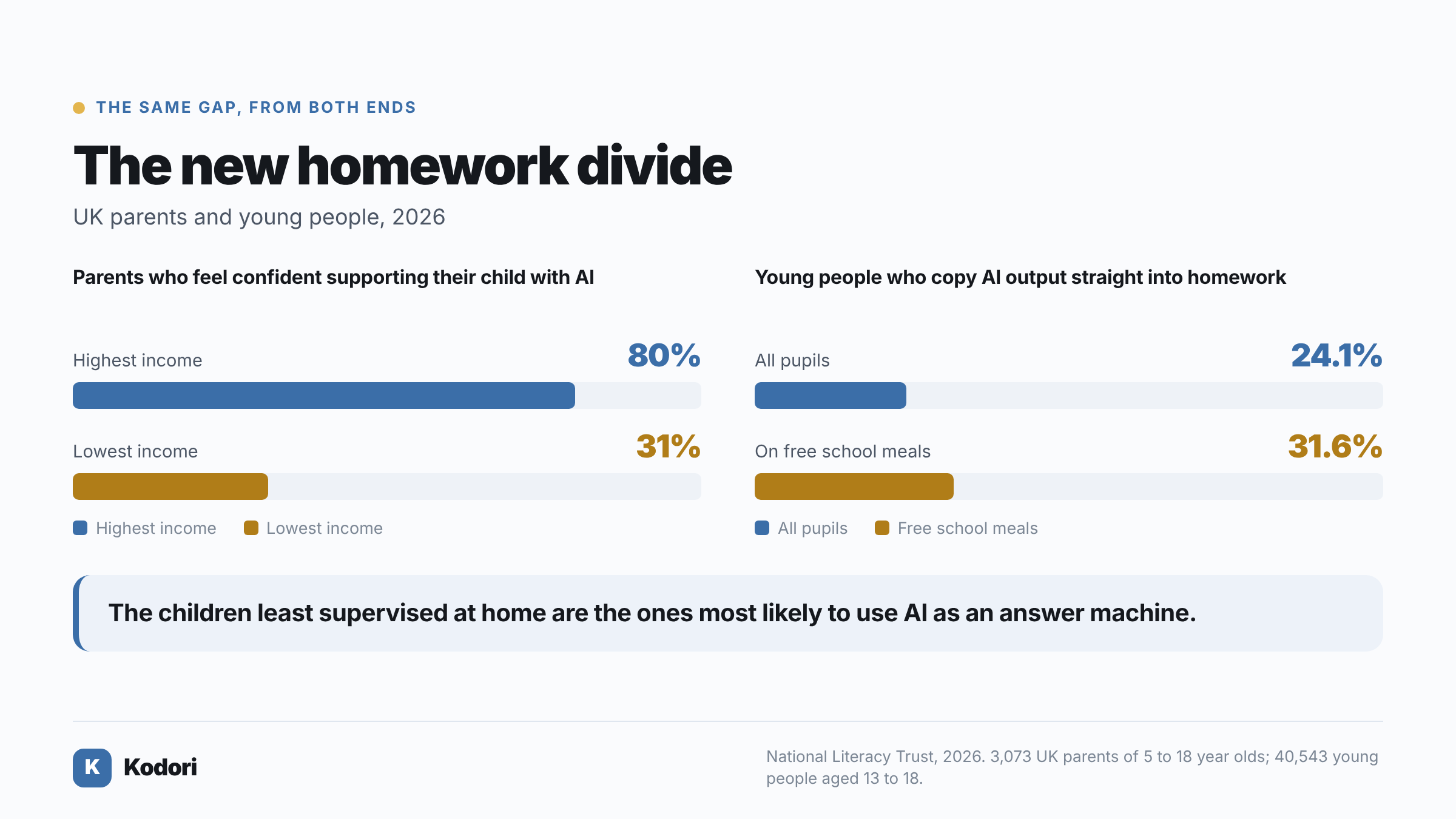
- 80.0% of the highest-income parents feel confident supporting their child with AI.
- 31.0% of the lowest-income parents feel the same.
A forty-nine point gap, in the same country, about a tool that is free to use.
The homework divide moved, and nobody announced it
That figure only becomes interesting when you put it next to one from the other end of the same research. Among 40,543 young people aged 13 to 18:
- 24.1% said they simply copy AI output into their homework.
- Among pupils receiving free school meals, that rises to 31.6%.
Read those four numbers together and they stop being two findings. The children least supervised at home are the ones most likely to use AI as an answer machine. The confidence gap and the copying gap are the same problem, seen from each end of the kitchen table.
An expert quoted in the same report described it as an equity issue, and put it better than we could: the real divide is now between students who can critically engage with what AI tells them and students who cannot.
What that looks like in a house
Two children get the same homework. Both get stuck. Both open the same free chatbot.
In the first house, a parent who feels confident with this stuff glances over, says “don’t just paste that in, do you actually get it?”, and makes the child explain it back. The tool has been turned into a tutor by one sentence from an adult.
In the second house, nobody is confident enough to say that sentence. Not because they care less. Because being told to supervise something you do not understand yourself is not advice, it is a burden. So the answer goes in, the homework is handed in, and the gap underneath it never surfaces.
Same tool. Same child, more or less. Completely different outcome, decided by whether an adult nearby felt able to intervene.
The schools have the same problem
It is tempting to say schools will catch this. The same research surveyed 2,567 teachers:
- 60.1% are worried about pupils using AI, up from 43.2% a year earlier.
- Only 32.6% have had any training in critical AI literacy.
Teacher worry is rising faster than teacher use. The people we would rely on to close the gap are themselves largely untrained for it, and they say so.
Meanwhile 62.5% of parents agree their child should learn about AI at school. The demand is there from both sides. The capacity is not there yet on either.
What would actually help
Not telling low-income parents to supervise harder. That is the advice equivalent of telling someone to simply have more money.
Tools that cannot be misused the way a general chatbot can. If a product will hand over a finished answer on request, it requires an adult standing behind it to be safe. If it will not, it does not. That is a design decision, not a parenting decision, and it is the one that actually closes the gap.
Products that never ask a parent to judge an AI output. The moment a service expects a parent to assess whether an explanation was correct, it has quietly excluded most of the people in that 31%. Anything a parent is given should be something they can act on without evaluating it: what their child worked on, what is still shaky, a sentence they can say out loud.
AI literacy taught in school, properly resourced. It is the only route that reaches children whose parents cannot do it, and two thirds of parents already want it. One in three teachers having had training is not enough to deliver it.
Where we stand
We built an AI tutor, so we have an obvious interest here and you should read the above with that in mind.
What we will say is that this research changed what we think we are selling. Kodori refuses to hand over answers by design, which means it does not need a confident adult standing behind it to be used safely. For a household where nobody feels able to supervise AI, that is not a feature. It is the whole point.
It is also a partial answer. It does not touch the children whose families cannot afford anything at all, and it does not replace a trained teacher. Those are the two biggest parts of this problem and a subscription product does not solve either of them.
If you want to know exactly how ours works, we have written down what happens to what your child types.
All figures in this article are from the National Literacy Trust’s 2026 report on young people’s, teachers’ and parents’ use of AI to support literacy: 40,543 young people aged 13 to 18, 2,567 teachers and 3,073 parents of children aged 5 to 18.